IN HONOUR OF PATRIARCH BARTHOLOMEW: ORTHODOXY AND ECOLOGY CONFERENCE by Ron Dart


Orthodoxy and Ecology Conference: “A Sacramental Approach to Ecology”
All Saints Monastery/Trinity Western University
October 6-7, 2017
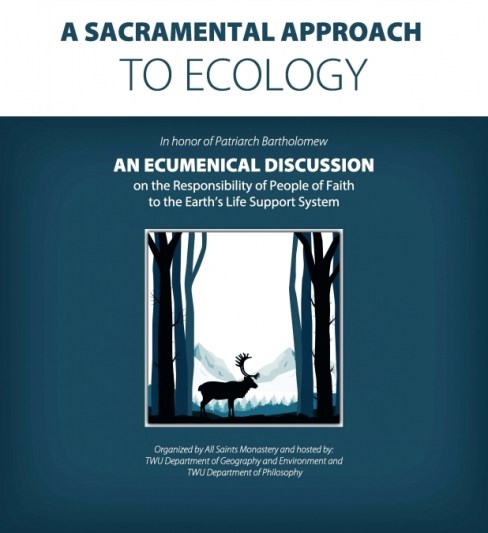
sacamental_ecology_poster-2During the spring and summer of 2017, retired Archbishop Lazar (Puhalo) of the Orthodox Church in America, David Goa (Orthodox), Brad Jersak (Orthodox), Chris Morrissey (Roman Catholic), and Ron Dart (Anglican) met a few times to organize an ecumenical conference on ecotheology, dedicated to the “Green Patriarch,” His All-Holiness Bartholomew I of Constantinople. The planning unfolded well and wisely. The opening session was scheduled for  the evening of Friday, October 6 at All Saints Monastery in Dewdney BC, while a full day was planned for Saturday, October 7 at Trinity Western University in Langley BC. 

A substantive group met at All Saints Monastery to launch the 2-day conference. Archbishop Lazar read “Reflections of the Ecumenical Patriarch Bartholomew I on the Christian Vocation of Ecology”—a fine and fit way to begin the conference.

Steve Bynum, an Orthodox Christian who is Senior Producer of Worldview Radio WBEZ in Chicago, moderated the evening. He allotted about 10 minutes to each of the three presenters: Father Nilos Nellis of the Archdiocese of Canada of the Orthodox Church in America, Chris Morrissey, and Ron Dart. Read More


REVISITING THE AGENDA OF THE NEO-PATRISTIC MOVEMENT by Viorel Coman

Florovsky-10

Father Georges Florovsky

The neo-patristic movement in 20th-century Orthodoxy included a group of theologians who advocated the need of Eastern theology to return to the Fathers of the Church in order to renew itself and depart from the influences of Western scholasticism, which had permeated its ecclesiology, ethics, and spirituality for centuries. It is primarily with the name of Georges Florovsky that the neo-patristic movement is associated: in 1936 he became the first theologian to become aware of Orthodoxy’s need to (i) recover its independence from Western scholastic patterns of thought and (ii) embrace a patristic-oriented approach to theology.

For this Russian theologian from the Parisian diaspora, such a restauratio patristica in Orthodox theology was not envisaged as a servile repetition of the Fathers of the Church, but as an organic continuation of the patristic endeavour by a creative incorporation of their spiritual experience into our own lives: “‘To follow’ the Fathers does not mean just ‘to quote’ them. ‘To follow’ the Fathers means to acquire their ‘mind,’ their phronema” (G. Florovsky, “St. Gregory Palamas and the Tradition of the Fathers,” pp. 109 and 113). Florovsky’s plea for the return to the Fathers was coupled with his emphasis on the permanent and eternal value of Hellenic categories for Orthodox theological thought. The call for a “return to the Fathers” has been so widely shared by Florovsky’s colleagues (Vladimir Lossky, Dumitru Stăniloae, etc.) that the search for a Neo-Patristic Synthesis in theology reached the point of dominating the Orthodox scene in the second half of the 20th century and beyond.

It is true that one can hardly deny the significant achievements of the neo-patristic movement for 20th-century Orthodoxy in theological areas such as christology, trinitarian theology, ecclesiology, anthropology, or eschatology. Yet, at the same time, one can also hardly fail to recognize that the neo-patristic movement’s emphasis on Orthodoxy’s need to liberate itself from Latin scholasticism, as well as its insistence on Hellenism as the perennial philosophical category of Christian existence, might—and actually did—induce in some circles a tendency towards ecclesial triumphalism and isolationism, as well as towards suspicion in regard to the West and to everything that could affect the “purity” of Orthodox theology and spirituality. Read More


MANY WOUNDS, ONE SAVIOR: FULNESS OF LIFE AFTER CLERGY ABUSE by Teresa Hartnett

This is the first in a series of related articles by this author. She writes directly from her experience as a Roman Catholic, yet the topic is no less relevant to the Orthodox Church.

jesus-healing-the-woman-with-a-disabling-spirit-600x620I was wounded at the nexus where the holiness of priests touches the innocence of children. In my case, that involved being sexually and emotionally harmed by a series of Catholic priests for a period lasting over a decade.  One day when I was nineteen years old, I drove away and did not return until many years later, after finally I had accepted the Lord’s indwelling. At the time of my escape, I had grown to hate the Catholic Church; but I nevertheless returned quietly, alone and guarded, to Mass, to Adoration and to praying my rosary. I was a stealth Catholic, until the emotional impact of what had happened drove me into exile. 

Contrary to media caricatures, I had no repressed memories.  Like fellow victims I compartmentalized the experience and, in particular, its traumatic emotions. Unfortunately, the emotions eventually bubble up. As adults, we find so many ways to outrun the past, or bury it. I was self-destructive, but called it “youth” as I just continued the harm started by my abusers. I was “high-functioning,” which only meant I carried a private shame agony that kept me isolated from people who were able to care about me—and for me. Busy with a good career in New York City, I thought it was all working. I thought I had escaped.

Then, it happened. I just hit a wall whose details I’ll spare you. It was awful. Someone suggested I try therapy, which I began with the enthusiasm of a neophyte. My goal was to change my life, start anew, as fast as possible. It never occurred to me that abuse, which was then five years behind me, was still pulling the strings in my emotional and spiritual life.  Read More


ANOTHER JANUARY, ANOTHER CELEBRATION OF OUR MORAL SUPERIORITY by Giacomo Sanfilippo

March-for-Life-2018-logo

I debated with myself on whether to call this article the celebration of our moral superiority, the commodification of our moral superiority, or the gentrification of our moral superiority. Pick one.

+

On October 10 Orthodoxy in Dialogue published my “Abortion, Contraception, and Christian Faith.” In a world where the tragic reality of abortion has always existed and will never go away, it argues—reluctantly, for I am the father of five and grandfather of two whom I would not wish unborn—it argues for the moral imperative of keeping abortion legal, accessible, and performed by properly trained and licensed medical professionals.

The premise of the article was meant to be simple, easily understood by all: when we cannot save two lives, we have a moral obligation to save one. If abortion stops a beating heart, back alley abortion stops two beating hearts. Ensuring the accessibility of legal abortion signals to a woman that the sanctity of life includes the absolute sanctity of her life, regardless of what decision she makes with respect to her pregnancy: we want our wife, mother, sister, daughter to come home from the clinic alive. Is this so hard to understand?

(NOTE: Canon 2 of St. Basil the Great shows no less concern for the life of the woman having an abortion than it does for the unborn child: “For in most cases the women die in the course of such operations.” St. Basil’s care for women’s lives goes completely unaddressed in the movement to deny women access to legal, professional abortion.) Read More