The unnamed dedicatee and addressee of Father Pavel Florensky’s 1914 The Pillar and Ground of the Truth was his fellow seminarian, roommate, and intended life-companion (спутник жизни, “husband”), the deceased Sergei Troitsky.
Florensky was obliged to delete “Friendship” from his master’s thesis at the Moscow Theological Academy because his academic supervisor deemed it to be too controversial to pass the examining board. His contemporaries understood that this was no theology of friendship in any conventional sense of the word.
When he reinstated the chapter for publication he was a married man, an ordained priest, and the father of his first child, still grieving the loss of his greatest love. He did not replace “Friendship” with a theology of marriage.
Two Worlds — Два Міра
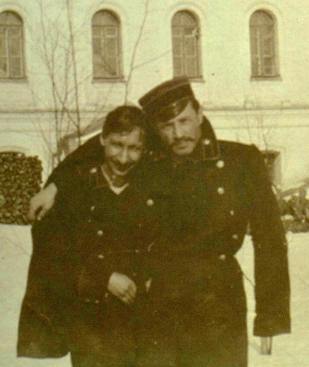
Pavel Florensky and Sergei Troitsky (Age 24 and 25 respectively)
My meek, my radiant friend!
Our vaulted room greeted me with coldness, sadness, and loneliness when I opened its door for the first time after my trip.
But, alas, I entered it alone, without you.
But you are not with me, and the whole world seems deserted. I am alone, absolutely alone in the whole world. Read More

 Alexander Chow’s Theosis, Sino-Christian Theology and the Second Chinese Enlightenment is an innovative and compelling attempt at utilizing an Eastern Orthodox framework to construct a contextual Chinese Christian theology. Largely successful in his endeavor, Chow’s much-needed inquiry into the potential for a Sino-Christian theosis-centered theology has him playing the role of Pandora opening a box with which Sino-Christian scholars will be forced to engage in the coming years.


 ORTHODOXY IN DIALOGUE