


DEAREST MR. PRESIDENT-ELECT: YOU OFFER HOPE FOR A BETTER FUTURE by Ecumenical Patriarch Bartholomew of Constantinople
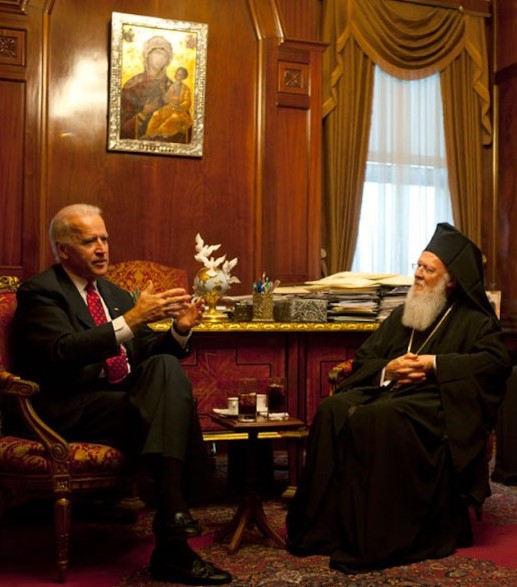
Vice-President Biden and Ecumenical Patriarch Bartholomew (2011)
✠
Dearest Mr. President-elect,
Since you are well aware of my sentiments for you throughout the years of our friendship, you can only imagine my great delight and pride for your successful election as 46th President of your prominent nation, the United States of America.
The joy and enthusiasm for your electoral success are not merely personal sentiments. They are also shared by our Ecumenical Patriarchate and its eparchies across the world, and above all by the Greek Orthodox Archdiocese of America with its commendable Shepherd, Archbishop Elpidophoros – and I remain grateful for the love and esteem with which you have embraced him. But beyond our Patriarchate, there are millions of Americans, as well as citizens of the entire free world, to whom you now offer hope (I could say conviction) for a better future, where the eternal values and ideals of a civilized humanity may prevail.
The Ecumenical Patriarchate has for many years been preoccupied with protecting the natural environment and addressing climate change, and so it especially celebrates the initiatives that you are prepared to assume on this urgent matter, as you have already declared, with regard to adhering to the Paris Agreement and assuring a cleaner environment.
Read MoreShare this:

4th Annual Christmas Appeal to Feed the Homeless

GOAL: $5000
COLLECTED TO DATE: $1,115
✠
~ DONORS ~
Grayson Alexander
Ioana Bertrand
Yvette Cuny
Dawn Drake
Theodoros Lambros
Father Sean Andrew Lotz
Grace Monk
Esther Robinson
Ihor Romaniuk
Giacomo Sanfilippo
Monica Spoor
Maria Tsikerdanos
Anonymous
Anonymous
Anonymous
Greetings to all our brothers and sisters in Christ around the world on this, the first day of our ascetical journey to the spiritual Bethlehem of our hearts, there to welcome anew the Birth of Our Lord, God, and Saviour Jesus Christ in the flesh.
The Holy Fathers are unanimous, and Orthodox Tradition unambiguous, on almsgiving as an essential dimension of the daily ascesis of our life in Christ, and of the intensified ascesis of the Church’s four lenten seasons.
We invite you to join us in our fourth annual mercy walk on Christmas Eve and Christmas Day to deliver cash into the hands of the homeless on the frigid streets of downtown Toronto. We have set as this year’s goal to give fifty individuals a gift of $100.
When we consider our Christmas budget for home decorations, festive meals, new clothes, and gifts for one another, let us ask ourselves how much we can give to those who don’t know whether or not they will eat on Christmas or where they will sleep that night.
Send your cheerful gift to editors@orthodoxyindialogue.com via PayPal and put “Christmas” in your message. We will update the amount collected and donors’ names in alphabetical order with every contribution received. Check back often to see how we’re doing.
Please pray for the success of our appeal, and for the homeless and the hungry everywhere. Christ Himself comes disguised as each and every one of them.
May He who comes to be born of the Most-Holy Theotokos and Ever-Virgin Mary bless you all with a spiritually fruitful and joyful Nativity Fast.
Share this:

IN CASE YOU MISSED IT: AUGUST, SEPTEMBER, OCTOBER

AUGUST, SEPTEMBER, OCTOBER 2020
Father Seraphim of Mull Monastery Forced to Address Orthodoxy in Dialogue’s Support for Him
Archbishop Elpidophoros at the Democratic National Convention
When Biography and Hagiography Collide
The Future of Orthodox-Catholic Relations in the USA
Metropolitan Theodosius and the OCA’s Breathtaking Historical Revisionism
The Limits of Academic Freedom
Review: Edge of the Abyss: The Usefulness of Antichrist Terminology in the Era of Donald Trump Read More


