ARE TURKEY’S CHRISTIANS AS “FINE” AS THEY SAY? by Fehim Tastekin

This article suggests that Patriarch Bartholomew headed a list of Christian leaders in Turkey who signed a misleading statement under indirect pressure from the Turkish government. It should be read in conjunction with Niko Efstathiou’s “Islamic Educational Center Planned Beside Ecumenical Patriarchate’s Shuttered Theological School,” which we published yesterday.

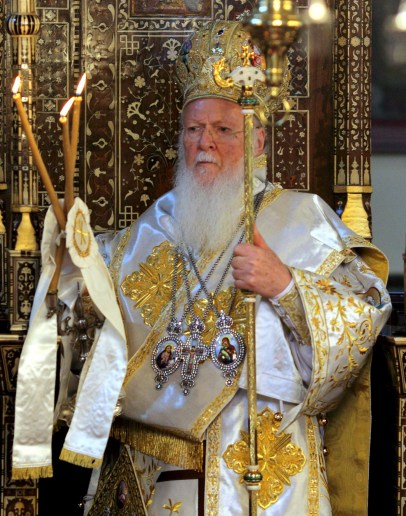
patriarchbartholomew-600x699As tensions simmered between Ankara and Washington over detained American pastor Andrew Brunson, the leaders of Turkey’s non-Muslim minorities issued a joint statement July 31 to deny that they faced any oppression in the country. The timing of the move was rather remarkable, and for Garo Paylan, an ethnic Armenian lawmaker for the Peoples’ Democratic Party (HDP), the issuance of such a declaration was “in itself a proof that we are not free.”

The 18 Christian and Jewish community leaders who signed the declaration asserted that they practiced their faiths freely, that “statements alleging and/or alluding to oppression are completely untrue” and that “many grievances experienced in the past have been resolved.”

Leading the signatory list was Greek Orthodox Ecumenical Patriarch Bartholomew I of Constantinople, whose community has been waiting for 47 years now to have its theological school reopened, followed by Archbishop Aram Atesyan, the acting spiritual head of the Armenian community, which is unable to elect its own patriarch because of government interference. Fourth on the list was Yusuf Cetin, the acting patriarch of the Syriac community, which has seen many of its church properties seized by the state, while most other signatories represented foundations crippled by red tape.

What led minority leaders to issue such a statement at a time when their misgivings are known to be on the rise? Read More


CONFESSIONS OF A CATECHUMEN AND EX-MARINE by N.

Addendum 7/3/19: The author contacted us today to request that we remove this article. As a compromise we have deleted all mention of his identity.
Addendum 4/23/20: See also Andrew Klager’s review of Documentary: J.E.S.U.S.A., a trenchant indictment of American militarism.

marines

War is hell. War is often unnecessary, but through the evil in our hearts we let it be and we encourage it, we engage it in fantasy primarily through Hollywood and gamer culture while imposing its deathly reality on people far weaker than us. We in these United States rarely see the suffering, the death, the disease, the famine that we impose on other nations. That we imposed on those peoples who are original to this continent. In the eyes of popular culture the soldier is not a harbinger of death, but a youthful soul seeking adventure who toughens up through the grim reality of combat.

Nothing could be further from the truth. War is death. War is hell on earth. In war we all die. Some of us physically, some of us mentally, some of us spiritually. In war, death is the only guarantee.

Memories

Memory #1
Marine Corps Recruit Depot San Diego June 2001

We are running in formation. A drill instructor (DI) leads the cadence (chant). The platoon responds in unison with KILL. We chant KILL every time our left foot strikes the pavement.

DI: I went to the church house where all the people pray

KILL

DI: I pulled out my rifle and blew them all away

KILL

DI: I went to the schoolhouse where all the kiddies learn

KILL

DI: I tossed in a grenade and watched those f*ckers burn

KILL Read More


APOCALYPSE SOON? A REFLECTION ON THE ANNIVERSARY OF HIROSHIMA AND NAGASAKI by Jim Forest

This week marks the 73rd anniversary of the destruction of Hiroshima and Nagasaki by the United States of America on August 6 and 9, 1945.

hiroshima3

In 1951, the year I turned ten, one didn’t have to be a grown-up to be aware that radioactive particles were in the air. Invisible cancer-causing debris was being carried by the winds from the deserts of Nevada to the far corners of the earth, and before long was being mixed with the fallout of Soviet, French, and British nuclear tests. Radioactive strontium-90 [90Sr] was making its way from mushroom clouds into the food chain, arriving finally in every bottle of milk.

I knew from close range what nuclear weapons could do to those targeted by them. In 1951 two young Japanese women, survivors of the atom bomb that had been dropped on Nagasaki on the 9th of August 1945, arrived in my home town of Red Bank, New Jersey. They were house guests of the local Methodist minister, Roger Squire, and his family. A national peace group had arranged for plastic surgeons in New York to treat some of the people who had been burned by the blasts. The Squires were providing hospitality for two of them. Thanks to my mother’s occasional attendance at Methodist services, I saw these very poised women sitting side-by-side in a pew near the front of the church, their damaged faces hidden behind silk veils. I couldn’t stop staring. Though I had seen a few post-explosion photos of the ruins of Hiroshima and Nagasaki, being in the same room with these two women bought home to me in a more intimate way the human dimension of war, the effects of nuclear weapons, and the fact that the victims of war were rarely those responsible for war. I was also old enough to be aware that taking Japanese victims of America’s atom bombs into one’s home was not something that all Americans would appreciate. In the ice age of the Cold War, such hospitality required courage. Read More


ISLAMIC EDUCATIONAL CENTER PLANNED BESIDE ECUMENICAL PATRIARCHATE’S SHUTTERED THEOLOGICAL SCHOOL by Niko Efstathiou

For the troubled recent history behind the present article see, among other sources, the website of the Ecumenical Patriarchate, Wikipedia, the Foreign Policy Association’s June 2014 “Obama Administration to Turkey: Reopen Halki Seminary” by Hannah Gais, and the recent statement of Greece’s Ministry of Foreign Affairs.

pjimage (13)

Halki Theological School (Θεολογική Σχολή Χάλκης)

The Holy Theological School on the island of Halki (Heybeliada), one of the Princes’ Islands in the Sea of Marmara, has remained closed for almost 50 years, yet not a year has passed without it attracting hundreds of visitors and international attention. However, it may soon be eclipsed by a more grandiose religious establishment. While negotiations about the reopening of the seminary remain ongoing, Turkish authorities have announced a plan to erect a colossal new Islamic educational center in the middle of the island.

According to an official announcement by Haydar Bekiroglu, president of the Turkish Directorate of Religious Affairs, a new center of Islamic studies spanning a total area of 200 acres is scheduled to be built on Halki, less than a kilometer away from the Orthodox seminary where no lessons have been held since 1971, following the introduction of a Turkish law banning private higher education institutions. Early last week Bekiroglu announced that the administration is already in talks with the local urban planning authorities, and hopes to get approval for the ambitious project soon.

The plans for the new Islamic educational center on the island off the coast of Istanbul are not an isolated incident. Over the past year, the Turkish government has made the expansion of religious education in major cities a clear priority. “It is urgent to strengthen the religious educational infrastructure in every corner of Istanbul, the cradle of our civilization,” said Bekiroglu in an official statement, adding that the majestic 200-acre institution will include dormitories that will host dozens of Islamic scholars from Turkey and abroad. Read More