MEETING WITH THE EXARCHS OF THE ECUMENICAL PATRIARCHATE: OFFICIAL REPORT FROM THE PRESIDENT OF UKRAINE

This report appeared earlier today on the Official Website of President Petro Poroshenko of Ukraine.

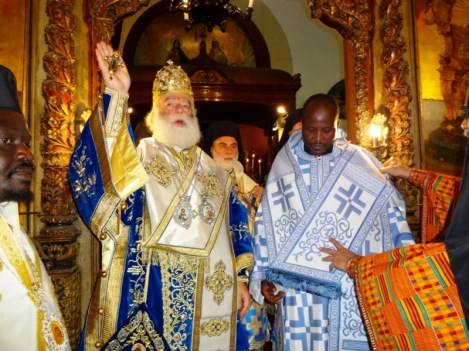
President Poroshenko (centre left), Archbishop Daniel (front right), Bishop Ilarion (rear right)

President Petro Poroshenko had a meeting with the Exarchs of the Ecumenical Patriarchate in Ukraine—Bishop Ilarion of Edmonton and the Western Eparchy of the UOC [Ukrainian Orthodox Church] in Canada and Archbishop Daniel of Pamphylia and the Western Eparchy of the UOC in the United States of America.

The Head of State emphasized that the beginning of the mission of the Exarchs of the Ecumenical Patriarchate in Ukraine, Archbishop Daniel and Bishop Ilarion, is an extremely important event for all Orthodox people in Ukraine.

Read More


THE CHRISTIAN RIGHT IS LOOKING TO PUTIN’S RUSSIA TO SAVE CHRISTIANITY FROM THE GODLESS WEST by Tom Porter

It is no secret that America’s “Christian right” includes a great many Orthodox Christians in the US, especially certain kinds of converts to Orthodoxy. In drawing this Newsweek article to our readers’ attention Orthodoxy in Dialogue invites one or more qualified individuals to write a thoughtful, analytical response.

WorldCongress_Logo_S

At a gathering of some of the world’s most virulent opponents of LGBT equality, Russian conservative activist Dmitry Komov warned of the destructive agenda underlying the spread of liberal values.

The West, he told a far-right French TV station in December, was committed to the “destruction of all of our collective identities: national identity, religious identity, gender identity,” and warned it would result in  “the destruction of human identity.”

Komov was in Chisinau, Moldova, for the Eurasian colloquium, where Russian Orthodox ideologues and European far-right activists rubbed shoulders. Between 13 and 16 September they are also joined by members of a U.S. conservative Christian groups in the city for the World Congress of Families [designated a hate group by the Southern Poverty Law Center]. The unlikely allies feel that after decades of struggle, the time has come to topple Western liberal hegemony.

Relations between Moscow and Washington have been strained over allegations that Russia influenced the 2016 election of President Donald Trump, but religious conservatives in both nations have recently found common cause.

Under President Vladimir Putin, Russia and parts of the U.S. Christian right have formed an alliance that would have been unthinkable just a few decades ago, when American evangelical leaders railed against “godless communism.”

Russia has reinvented itself as a bastion of Christian values in a world beset by relativism and godlessness. As a result, conservative Christians gathering at the World Congress of Families are looking to Putin to protect Christianity from the West. Read More


UKRAINIAN AUTOCEPHALY: ECCLESIOLOGY, ECUMENISM, POLITICS by Andrew Sorokowski

2hx13o

In the western Ukrainian city of Lviv in the spring of 1990, one could sometimes hear the phrase katafal’na tserkva—катафальна церква, “catafalque church”—a folk rendering of avtokefal’na tserkva or “autocephalous church”—автокефальна церква. Indeed, the concept of an autocephalous Ukrainian Church was thought to have died at the end of World War II, except in the Ukrainian diaspora.

But in August 1989, the Russian Orthodox parish of SS. Peter and Paul had opted for Ukrainian autocephaly, and in November 1991 the Russian Orthodox Exarchate of Ukraine, now rebranded as the Ukrainian Orthodox Church (UOC-MP), declared itself autocephalous. The Moscow Patriarchate reacted swiftly, forcing Metropolitan Filaret (Denysenko) to resign the following year, and eventually laicizing and anathematizing him. The UOC returned to the Russian fold. But within a few years two new autocephalous churches—the Ukrainian Orthodox Church of the Kyivan Patriarchate (UOC-KP) and the Ukrainian Autocephalous Orthodox Church (UAOC)—had sprung up.

Today, neither the UOC-KP nor the UAOC is recognized as canonical in the Orthodox world, and the Russian Orthodox Church (ROC) as well as the UOC-MP regards them as schismatic. But according to a Kyiv International Institute of Sociology survey taken last May and June, 43% of Ukrainians identify with one or the other of these autocephalous churches, while only 17% adhere to the canonical UOC-MP. Russia’s 2014 annexation of the Crimea and its war in the Donbas have alienated many Orthodox believers in Ukraine, and entire parishes have defected to the autocephalous Churches. Read More