LGBTQ+ IN OUR CHURCHES by Protodeacon Theodore Feldman

In a climate of fear where Orthodox bishops and clergy feel that they have to come to us “by night,” as it were, to express their support for Orthodoxy in Dialogue’s commitment to keeping sexuality and gender front and centre of intra-Orthodox debate—and where one bishop is even forbidden by the Holy Synod of his jurisdiction to publish his views on these questions—we thank Protodeacon Feldman for his courage in attaching his name to the following brief reflection. We pray that others of his fellow clergymen and some of our hierarchs become equally emboldened to speak out publicly. Orthodox children, women, and men whose sense of personal identity falls somewhere along the LGBTQ spectrum are literally craving to hear from you.
photini

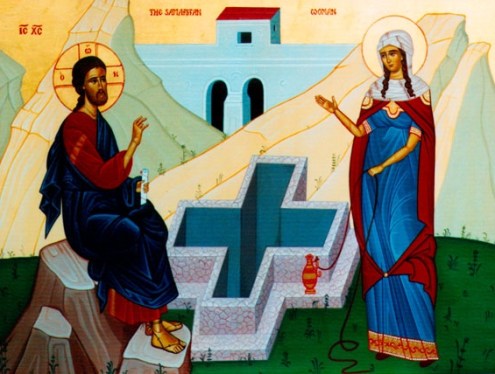
Christ and St. Photini (Svetlana) at the Well

I want to offer a few brief observations regarding persons identifying as LGBTQ+ in our churches: observations from Scripture, from Tradition, from worship, and from experience.

From Scripture

The Old Testament book of Leviticus includes many commandments that we do not keep—for example, do not wear clothing woven of two kinds of material (19:19), do not trim your beard (19:27), do not sacrifice an ox outside the camp (17:3-4), render “an eye for an eye, a tooth for a tooth” (24:19-20). Those who cite 18:22 and 20:13 (do not “lie with a male as with a woman”) as prohibitions against homosexuality pluck them from a whole that we no longer countenance. In doing so—in selecting those commandments that they consider applicable to our culture—they confess to discerning how to apply Scripture to our lives. But then we may contest their discernment and counter that these verses, like the others, do not make sense in our culture. Read More


A CATHOLIC RESPONSE TO THE VATICAN’S “MALE AND FEMALE HE CREATED THEM” by Kevin Elphick

eunuch (2)

St. Philip and the Ethiopian Eunuch. Menologion of Basil II. Circa AD 1000.

✠

There is neither male nor female, for you are all one in Christ Jesus.

Gal 3:28

Much has been made of the timing of the publication by the Vatican’s Congregation for Catholic Education of their document, “Male and Female He Created Them: Towards a Path of Dialogue on the Question of Gender Theory in Education” [full text at Zenit], during LGBT Pride Month. Yet little attention has been given to the date the document was actually promulgated: the Feast of the Presentation [“the Meeting” in Orthodox parlance]. If one assumed a pedagogical intent from the Congregation for Catholic Education, the selected date celebrates a cast of seeming sexual misfits announcing the dawn of a new age for human sexuality.

Present at the Temple are Joseph, who has specifically not fathered the Child; Simeon, who announces that he is now ready for death upon seeing the infant Messiah; Anna, an 84-year old prophetess who has spent the majority of her life as a widow; and the Virgin Mary. The irony inherent in the biblical account is that Mary and Jesus are there for “their purification according to the law of Moses” (Lk 2:22), as if the birth of the Messiah had actually rendered Mary ritually unclean (Lev 12:1-4). Both Simeon and Anna prophetically upend messianic expectations, announcing to all a newborn Child-Messiah. The feast day upon which the document is promulgated is a celebration of transcended genders, explicitly because in the Incarnation human sexuality is divinized. The Roman liturgy’s responsory for the day reflects this transformation of gender: Zion, let your wedding chamber be prepared to receive Christ your King. The Virgin conceived and gave birth to a Son, yet she remained a virgin forever. Read More


A VIRTUAL LISTENING TOUR: Brief notes on a teenaged boy

This is the ninth instalment in Orthodoxy in Dialogue’s Fifty Years after Stonewall: A Virtual Listening Tour. We urge our readers to forward the articles in this series to their diocesan bishops and parish priests. We beg our hierarchy and clergy to listen, attentively, reflectively, and prayerfully.
We ensure complete anonymity if you wish to write for this series between now and the end of June.

rainbow-png-transparent-background

This is editor Giacomo Sanfilippo. I want to share my brief memories of an Orthodox boy of 15 whom I met online in 2005 or 2006. Back in the days when Yahoo! Groups was the main way to communicate with large numbers of people, I started a group called Orthodoxy and Homosexuality, later renamed Christianity and Homosexuality. Our readers will recall that it was through this group that Eric Iliff of blessed memory came into my life.

This was also how I met Justin. He must be in his late 20s by now. He found his way to the group through an online search, introduced himself to the members, and shortly afterward began to email me privately for emotional and spiritual support. The photo he sent me showed an all-American boy with silky blond hair hanging over his blue eyes, the kind of son any parents would love to call their own. He was Orthodox. He loved attending the divine services, loved God, and loved and trusted his parish priest. The priest loved him. Read More


A VIRTUAL LISTENING TOUR: A seminarian speaks out

This is the eighth instalment in Orthodoxy in Dialogue’s Fifty Years after Stonewall: A Virtual Listening Tour. We urge our readers to forward the articles in this series to their diocesan bishops and parish priests. We beg our hierarchy and clergy to listen, attentively, reflectively, and prayerfully.
We ensure complete anonymity if you wish to write for this series between now and the end of June.

rainbow-png-transparent-background

I write these notes “from the road,” so to speak. As a bisexual Orthodox Christian convert, my life of faith has not been an easy journey. As someone who inhabits all these experiences and feels a call to ministry, it has recently become even more challenging. Finishing my first year of seminary, I am only now beginning to realize the many obstacles our Church has placed before my desire to serve God’s people.

I speak to our bishops as one with a deep love for our faith, and I carry a sorrow that the fulness of this faith has been denied to my LGBT brothers and sisters, many of whom have been excommunicated from the Church. I cannot imagine the heartache that cradle Orthodox Christians must feel when their loves are demonized and they lose their place in the Church that has been a home for them for their entire lives. But as a convert, I do know what it means to feel like a stranger in one’s own country, and it is my continual desire to welcome all people into the family of God as surely as I have been welcomed. Read More