
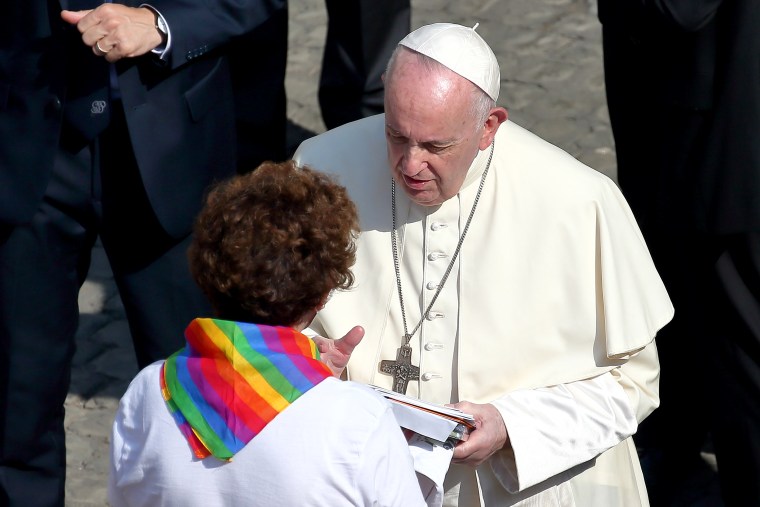
Photo Credit: NBC News
When the secular media reports on issues Orthodox or Roman Catholic, we do well, as a matter of course, to check official ecclesiastical sources to get the true story and avoid hasty conclusions. Whether from geniune ignorance, or from an instinct always to sensationalize the news in bright colours where grey shades of nuance are needed, or from space and time constraints in written and televised reporting, or from a combination of the three, the media never gets it right. The matter being reported is never as rosy or as awful as we’re led to believe.
Since yesterday, social media has been alight with the report that Pope Francis has authorized the blessing of same-sex couples. LGBTQ Catholics and Orthodox and their allies have waxed euphoric over this “baby step” towards Rome’s full acceptance of same-sex marriage. A young Orthodox queer woman wrote to Orthodoxy in Dialogue this morning to proclaim, “Finally, a pope who is like Jesus: loving and kind, accepting, and healing. Love casts out fear. Of course, some hypocrites will rage and hate.” The well-known Jesuit advocate for LGBTQ Catholics, Father James Martin (whom I’ve interviewed twice for Orthodoxy in Dialogue), has joined in the jubilation, even while acknowledging (but almost dismissively) the severe limitations in the Vatican’s Declaration.
After reading one or two reports in the mainstream media, I went to Vatican News’ summary of this development, entitled, “Doctrinal Declaration Opens Possibility of Blessing Couples in Irregular Situations.” Vatican News links to the document itself, entitled, “Declaration Fiducia Supplicans [Supplicating Trust]: On the Pastoral Meaning of Blessings.” At the head of the latter, you can click on the language of your choice: Italian, French, English, German, or Spanish. I recommend reading both the Vatican News report and the Declaration. Although the Declaration is formatted as a single long page containing the text in all five languages, each version comes to the equivalent of some five and a half pages. It’s well worth the effort and time to read, considerably shorter than most long-form internet articles.
(The title of official papal and Vatican documents is almost always taken from the first two words of the document. This Declaration opens with, “The supplicating trust of the faithful People of God receives the gift of blessing that flows from the Heart of Christ through his Church.”)
What follows below are short excerpts from the Vatican News report, with brief commentary of my own. I apologize in advance if I rain on this parade. There seems to me hardly anything to celebrate. I’ve commented on social media that this “blessing” is worse than no blessing at all. I state my case. You be the judge and form your own conclusions.
The excerpts below are indented. My comments return to the left margin. All italics are my own.
***
As reported by Vatican News:
…[I]t will be possible to bless same-sex couples but without any type of ritualization or offering the impression of a marriage. …[T]he blessing does not signify approval of the union.
First and foremost, the Declaration does not authorize the blessing of same-sex relationships, even when the couple is committed to what I have called elsewhere the asceticism of monogamy. Authorized is the blessing of the persons in the relationship. Presumably, what is envisioned is a “spontaneous” 2-second blessing with the cleric’s hand, with or without an impromptu prayer of his composition.
However, this gesture of pastoral closeness must avoid any elements that remotely resemble a marriage rite.
Aside from the requirement that the blessing not resemble the marriage rite in any way whatever, this also means no tuxes, no wedding gowns, no rings, no boutonnieres, no bouquets, no guests seated in rows, nothing inside the church building. (More on this below.) In his interview linked above, Father Martin rejoices that he can now bless same-sex couples in their back yard. When I was a priest serving in country parishes and visiting the farmers in my care, we went outside to bless cows. Martin himself draws this unfortunate analogy in his interview when he says, “The irony is, as a Catholic priest, you can bless all sorts of things. You can bless dogs, you can bless sheds, you can bless schools, you can bless factories. But up until now, you couldn’t bless same-sex couples, which really struck people as really unjust.”
The document explores the theme of blessings, distinguishing between ritual and liturgical ones, and spontaneous ones more akin to signs of popular devotion. It is precisely in this second category there is now consideration of the possibility of welcoming even those who do not live according to the norms of Christian moral doctrine but humbly request to be blessed.
From an Orthodox perspective, this seems typical of the legalism of Roman hair-splitting: not this kind of a blessing, but that kind of a blessing. Same-sex Catholic couples committed to reciprocal monogamy are to be welcomed in the Even Those category of human beings.
Those who ask for a blessing show themselves “to be in need of God’s saving presence” in their lives by expressing “a petition for God’s assistance, a plea to live better.”
…[T]his kind of blessing “is offered to all without requiring anything,” helping people feel that they are still blessed despite their mistakes and that “their heavenly Father continues to will their good and to hope that they will ultimately open themselves to the good.”
…[T]he ordained minister may join in the prayer of those [homosexual] persons who “although in a union that cannot be compared in any way to a marriage, desire to entrust themselves to the Lord and his mercy, to invoke his help, and to be guided to a greater understanding of his plan of love and of truth.”
…[T]hese blessings…represent a sign for those who “recognizing themselves to be destitute and in need of his help—do not claim a legitimation of their own status, but who beg that all that is true, good, and humanly valid in their lives and their relationships….
Although the couple is blessed but not the union…in “a brief prayer preceding this spontaneous blessing, the ordained minister could ask that the individuals have peace, health, a spirit of patience, dialogue, and mutual assistance—but also God’s light and strength to be able to fulfill his will completely.”
Nor can [the blessing] be performed with any clothing, gestures, or words that are proper to a wedding.”
…”[E]ven when a person’s relationship with God is clouded by sin, he can always ask for a blessing”
I should also note the frequency with which this blessing is qualified as “spontaneous.” This is no different from an Orthodox Christian asking the priest for a blessing when they meet by chance on the streets.
The implication is unambiguous: the Vatican’s intention is that self-loathing, “destitute” homosexuals in a committed relationship “spontaneously” ask for, and receive, a blessing on their persons but not on their union, and that, in the best of all worlds, the grace of the blessing will enlighten them to renounce and walk away from their sinful relationship.
The irony in the Vatican’s insistence that “this kind” of a blessing in no way confers legtimacy on the same-sex relationship is that in Latin, Greek, Slavonic, and many other languages, the verb “to bless” and its cognate noun, “a blessing,” mean etymologically to say a good thing about something, to say that something is good, to proclaim something as good, and by extension, to make something good.
This Declaration is less than a crumb from the Master’s table.
See our extensive Sexuality and Gender section in both archives linked at the top of this page.
Giacomo Sanfilippo is the founding editor of Orthodoxy in Dialogue and a PhD candidate in Theological Studies at Trinity College in the University of Toronto, writing on Father Pavel Florensky’s 1914 theology of male-male love. He holds an MA First Class in Theology from Regis College/St. Michael’s College with a thesis on his Orthodox theology and spirituality of same-sex love, and an Honours BA in Sexuality Studies from York University. He is also an alumnus of the Mark S. Bonham Centre for Sexual Diversity Studies at the Universoty of Toronto. Earlier in life he completed the MDiv, minus the thesis, at St. Vladimir’s Seminary.

 ORTHODOXY IN DIALOGUE